The feast of Saint Martin of Tours is one of the oldest feasts in the Church for a saint who was not a martyr. Saint Martin lived in the mid-300s, a time when the age of the martyrs had drawn to a (temporary) close, after Emperor Constantine’s edict granting legal protection to Christians throughout the Roman Empire to worship God. But Christians had become accustomed to the idea that it was external persecution that purified the faithful and made them fit for heaven. There was a certain worry that, if there were no more martyrdoms, there would be no more path to heaven.
It was in this context that the great confessor saints begin to rise. Saint Anthony of the Desert taught the Church by his very life that a Christian’s steadfast observance of God’s law, along with a life of earnest prayer, is just as much a battle–with just as great a prize–as that of bloody martyrdom. His motto might have been, “If the devils are no longer attacking us in the cities, let us go out to the wilderness to do battle with them there.” Saint Martin, in the Christian West, gave a similar example. From a young age, he had been enrolled in the Roman army. It was during his service that one of his famous works came about: he came across a poor man, barely clothed (and certainly too lightly for the winter chill) outside Amiens. Martin took his sword, cut his heavy soldier’s cloak in half, and gave the one half to the poor man. A Roman soldier owned half of his equipment–the other half was paid for by the army–and so, in effect, Martin was giving the man all that belonged to him. That evening, Martin saw a vision of Christ clothed with the half of the cloak Martin had given away. Christ was telling His angels, “Martin clothed me with this, and he is only a catechumen.” It was as if to say, “What you do for the least of my brethren, you do for Me.”
Martin sought baptism soon after this vision, moved by Christ’s love for him. He was made an acolyte, and eventually he was elected bishop of Tours. His charity, patience, and prudence were widely renowned. In particular, Martin was an adept mediator of disputes. As an elderly man, he went to bring peace in a dispute among his clergy in the town of Candes. Having succeeded in his mission there, he fell ill and knew that his death was approaching. The faithful who were traveling with him were distraught at the prospect of losing their faithful shepherd: “Savage wolves will attack your flock, and who will save us from their bite when our shepherd is struck down?” Martin, moved by such a piteous plea, prayed to God, “Lord, if your people still need me, I am ready for the task. Thy will be done.”
The liturgy commemorates this beautiful moment of pastoral solicitude in the Matins responsory: “O man truly blessed, Bishop Martin, who neither feared to die nor refused to live!” This can be our lesson: all things are for the sake of God’s will, and the coming of His kingdom. We advance that kingdom, which is indeed a spiritual kingdom, even by the very concrete and material assistance we give to the poor. This world matters, not because it endures forever, but because it is here that we determine to serve God or to refuse His service. And what we do in charity for the least of Christ’s brethren, we do for Him, which is what makes them return to Jesus, “glorifying God in a loud voice” as the cured leper in today’s gospel did. At the end of this life, the one who is faithful to God in service to the poor will hear those sweet words of consolation: “Well done, good and faithful servant: you have been faithful in a small matter: I will place you over great things. Come, enter your Master’s joy.”
Saint Martin, pray for us!
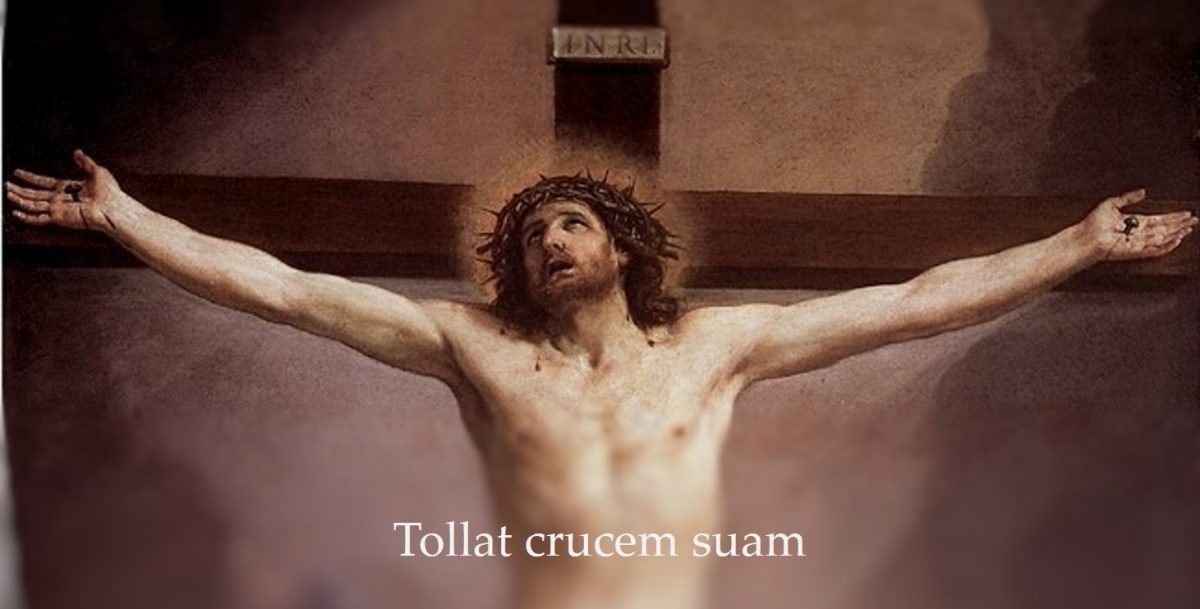
 Tollat crucem suam